Repair or replace
An Older Wolf Gas Cooktop: Igniters, Valves, or Time to Move On
Burner valve, defined
A burner valve is the brass body behind each knob that meters gas to one burner, turning the stem you rotate into a flame that can be held anywhere between wide open and a bare simmer. It is not the electrode that lights the gas and it is not the orifice that limits how much arrives, though a knob that feels wrong gets all three blamed at once. Wolf Repair Pro Los Angeles meters before it quotes — (310) 742-8625.
The three parts an older gas top wears out
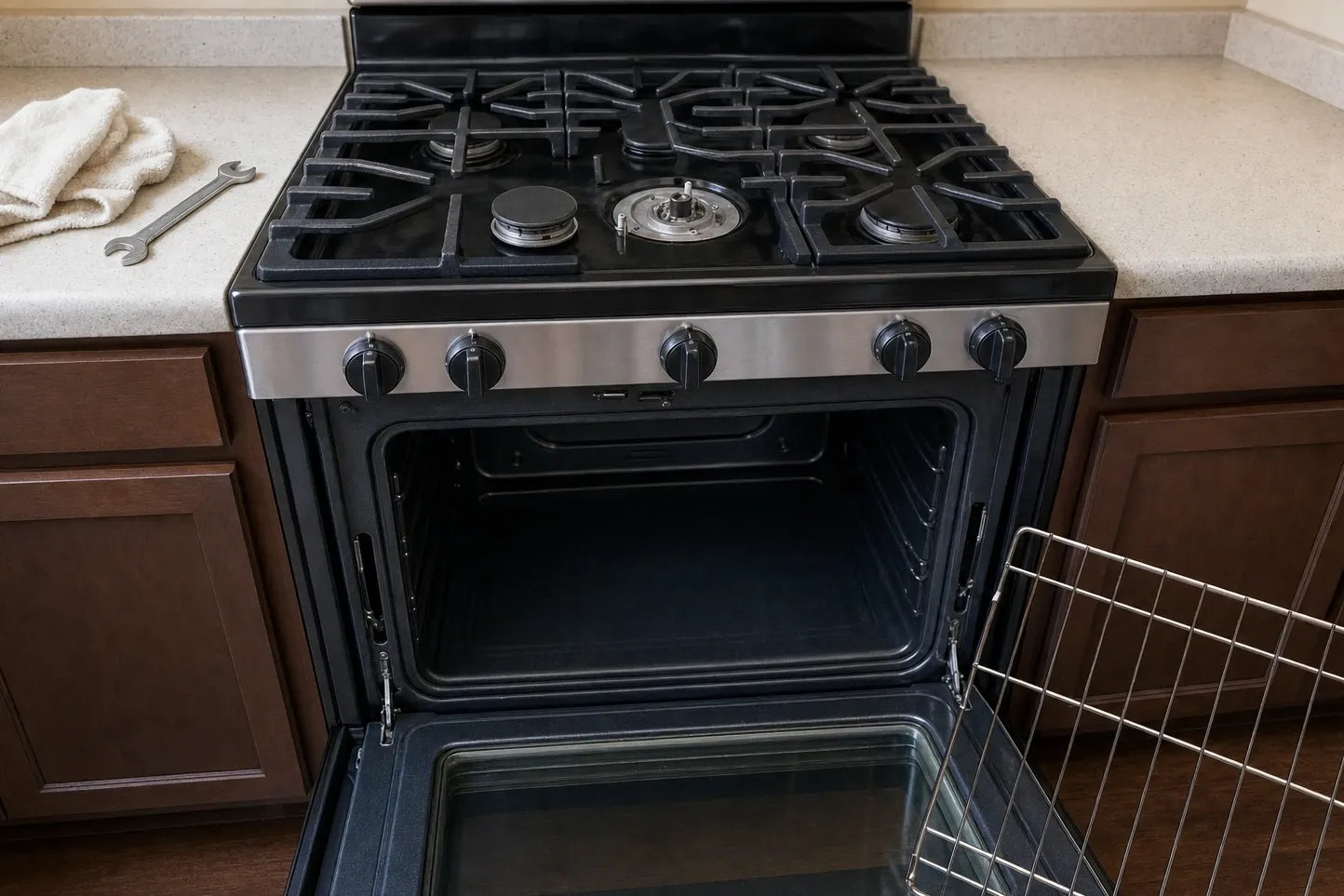
Wolf describes its gas burners as dual-stacked and sealed, and sealed is the word that matters to an ageing appliance: what boils over stays on the deck rather than dropping into the burner box below. Wear collects at three points instead: the electrode that throws the spark, the module that generates it, and the valve behind each knob.
People search for stove burner repair and mean this page: the burner itself is a cast head on a sealed base and almost never wears out. The three parts around it do.
Electrodes crack their insulators and leak their spark sideways to the nearest metal rather than across the gap. Modules weaken. Valves lose the grease that lets a stem turn smoothly against its taper, and the low end of the flame goes with it. A burner that clicks and never catches is the commonest of the three, and has a guide of its own on this site.
Why a simmer that roars is a valve and not a setting
Set a knob to its lowest mark and the flame should drop there and stay put through a stir. When it will not, the cap gets cleaned first and the orifice blamed second. Neither sets the low end. The valve does, through the taper the stem turns in and the small passage that keeps a flame alight once the main port has shut.
A worn taper is not brought back by adjustment: what has gone is the fit between two machined faces, and the part that restores it is a valve. Where those burners sit over an oven, the same fault comes under range repair rather than cooktop work.
What ages a top on this side of the city
Two climates, two failures. Out on the Westside, in Mar Vista and Palms, the air carries salt. It settles on electrode pins and lead terminations and leaves a film a spark tracks across instead of jumping, so a coastal kitchen wears out its ignition first.
Over the hill in Encino it goes the other way. Dust, long dry heat and a supply that sags on the worst summer afternoons: electronics notice all three, and brass valves notice none. The same model arrives from the two neighbourhoods with different faults.
The one thing that ends it: a part with no number left
Age on its own finishes nothing. An electrode is an electrode and a module is a module; while the number behind one is still supplied, the arithmetic stays on the repair side. What ends a cooktop is a valve with no living number and no substitute that fits the manifold.
Two other endings are worth naming. A deck corroded through around the burner ports, because the seal that kept spills out has gone too. And a third or fourth valve failing after the first two were replaced, which is the manifold telling you its age. Owners who reach that point often ask about moving from gas to induction, a different job, with other trades in it.
Follow-ups
Is clicking without lighting always the electrode?
Not always. The same hesitation comes from a module running out of output, and from a burner cap sitting a fraction out of place after a clean. All three get checked on the visit rather than swapped in turn. Wolf Repair Pro Los Angeles quotes once it knows which — (310) 742-8625.
Can I clean or adjust the burner valve myself?
No, and we would rather you did not. A valve sits behind the knob on the gas side of the appliance, which puts it outside anything an owner should open. Caps, grates and visible blockages are yours; the rest is ours. Wolf Repair Pro Los Angeles, (310) 742-8625.
How old is too old for a Wolf gas cooktop?
Age is the wrong measure. What decides it is whether the parts that wear are still listed, and whether the deck and manifold under them are sound. Tops well past twenty years are often worth repairing, and newer ones sometimes are not. Wolf Repair Pro Los Angeles will say which yours is — (310) 742-8625.